
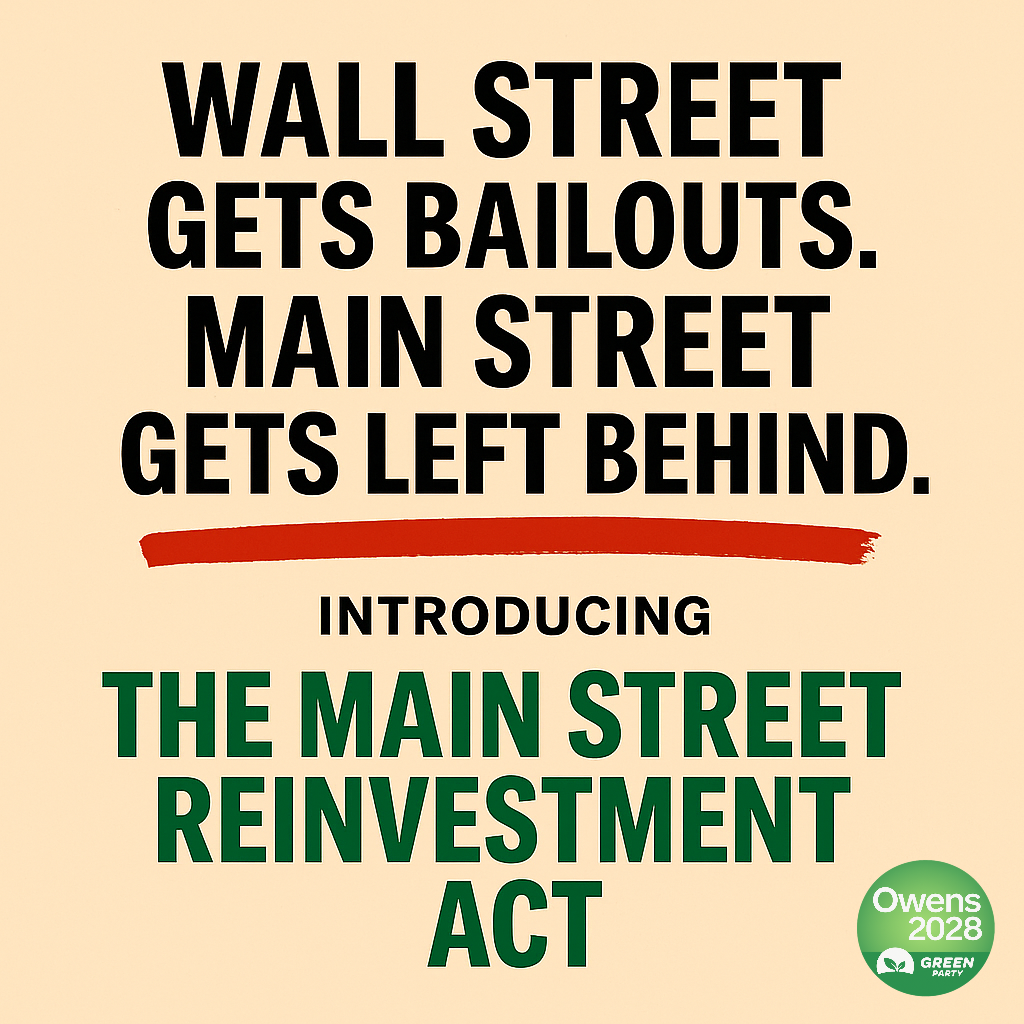
Wall Street vs. Main Street – Rebuilding Local Economies
When Americans talk about the economy, most of us don’t think about Wall Street tickers or hedge fund portfolios.
We think about paychecks, small businesses, and whether our communities are thriving.
But for decades, Washington has measured the economy by Wall Street’s health, not Main Street’s reality.
- Big banks post record profits while rural towns lose their last grocery store.
- Corporate stock buybacks hit all-time highs while small businesses can’t get loans to expand.
- Trillions in taxpayer bailouts go to the financial elite, while families fight foreclosure and medical debt.
The message has been clear:
If you’re part of the elite economy, you win. If you’re part of the people’s economy, you wait, you work, and you fall behind.
The Populist Problem: The Rigged Economy
Our economy isn’t broken by accident—it was designed to serve the top 1% first and everyone else last.
Here’s how we got here:
1. Wall Street Gambles, Main Street Pays
Wall Street isn’t just about trading stocks.
It’s about speculative financial games—derivatives, high-frequency trading, hedge fund bets—that produce billions in profit without creating a single job.
When these bets go wrong, we pay the price:
- 2008 financial crisis: Wall Street got bailed out, Main Street got foreclosed on.
- COVID-era speculation: Billionaires gained trillions in wealth, while small businesses shuttered permanently.
2. Small Businesses Are Left Behind
Small businesses are the backbone of American communities:
- They create nearly half of all jobs in the country.
- They keep wealth circulating locally instead of sending it to shareholders overseas.
Yet:
- Big banks deny small business loans while handing out credit to large corporations.
- Corporate chains and private equity buy out or drive out local competitors.
- Tax codes and subsidies favor the biggest players, leaving small operators to fend for themselves.
3. The Wealth Funnel Effect
For decades, both major parties have played the same game:
- Cut taxes for the wealthy.
- Deregulate Wall Street.
- Pretend “trickle-down” will fix everything.
The result is a funnel economy:
- Wealth flows up to the top, leaving local communities dry.
- When crises hit, bailouts flow back down to the elite first, not to the people who actually build the economy.
Populism calls this out for what it is:
An economy rigged by the few, for the few—while the many struggle to survive.
The Green Budget Solution: Main Street Reinvestment Act
The Green Budget Framework answers the economic rigging with a people-first solution: the Main Street Reinvestment Act.
This Act is designed to take economic power back from Wall Street and deliver it to Main Street, where it actually grows jobs and communities.
1. The Wall Street Transaction Tax
At the heart of the Act is a tiny tax on Wall Street trades:
- A fraction of a penny on every speculative trade—including high-frequency trading, derivatives, and short-term speculation.
- This does not affect ordinary Americans investing in retirement or college savings.
- It only taps into the billions moving between hedge funds and large investment banks every day.
Impact:
- Generates hundreds of billions annually without touching working families.
- Slows down predatory speculation that destabilizes the economy.
2. Funding Local Economies
Revenue from the transaction tax flows directly into Main Street, not Wall Street:
- Small Business Grants and Loans: Affordable funding for local entrepreneurs.
- Community-Owned Projects: Support for co-ops, local farms, and neighborhood revitalization.
- Downtown Revitalization Programs: Restoring and reopening vacant buildings, creating spaces for local commerce.
3. Empowering Local Banks and Credit Unions
To break Wall Street’s chokehold on credit:
- Funds support community banks and credit unions, giving them the resources to lend locally.
- Encourages local ownership of financial power, instead of letting mega-banks decide which towns get to survive.
4. Job Creation Through Community Investment
The Act creates a cycle of opportunity:
- Small businesses expand → Local hiring increases → More money circulates locally → Communities thrive.
- Unlike Wall Street speculation, local investment multiplies itself, building sustainable economies.
Cross-Party Appeal: Why Everyone Wins
The Main Street Reinvestment Act isn’t about partisanship—it’s about people over profit, and it delivers benefits across the spectrum:
- Republicans:
- Strengthens small business and entrepreneurship, core conservative values.
- Keeps local control of local economies, instead of letting D.C. or mega-banks dictate survival.
- Democrats:
- Advances economic fairness and job creation in struggling communities.
- Ends trickle-down lies, delivering bottom-up economic growth.
- Independents & Non-Voters:
- A common-sense plan that bypasses partisan gridlock.
- Offers tangible local results instead of campaign promises that never materialize.
This is populism in action—an economy that finally serves the people who build it, not the people who exploit it.
What Real Change Looks Like
Picture the impact five years after the Main Street Reinvestment Act takes effect:
- Vacant downtown buildings reopen as coffee shops, hardware stores, and local businesses.
- Family-owned farms and co-ops thrive, because they can access credit and community investment.
- Young people stay in their hometowns, because real jobs and opportunities exist locally.
- Wealth circulates inside communities instead of being siphoned away by Wall Street.
This is the opposite of the Wall Street economy.
It’s an economy we can see and feel in our neighborhoods.
The Ripple Effect: From Main Street to the Nation
Reinvesting in local economies does more than create jobs:
- Boosts home values as communities stabilize and grow.
- Reduces poverty and crime by replacing economic despair with opportunity.
- Builds resilience—local economies weather national crises better when they’re self-sustaining.
Every dollar Wall Street speculates might make an elite richer.
Every dollar we invest in Main Street makes America stronger.
Where We Go Next
Education and local economies are the first two pillars of taking America back.
- Episode 1 introduced the fight against a rigged system.
- Episode 2 showed how No School Left Behind secures our kids’ future.
- Episode 3 proves that economic power belongs with the people, not the banks.
Next, we move to a battle for the basics—housing, dignity, and the right to a stable life.
I’m traveling coast to coast, meeting Greens, supporting down-ballot candidates, and connecting with you directly where you are. Unlike career politicians, I fund my journey by working gigs like DoorDash and Instacart—time that could be spent building real change.
If you believe in this movement and want to help me dedicate more of my time to meeting voters and supporting our shared mission, click the image below to show your support. Together, we can build something lasting for 2026, 2028, and beyond.

Episode 4: “Shelter & Soul – How We Solve America’s Housing Crisis”
Because no one should be homeless in the richest country on Earth.