
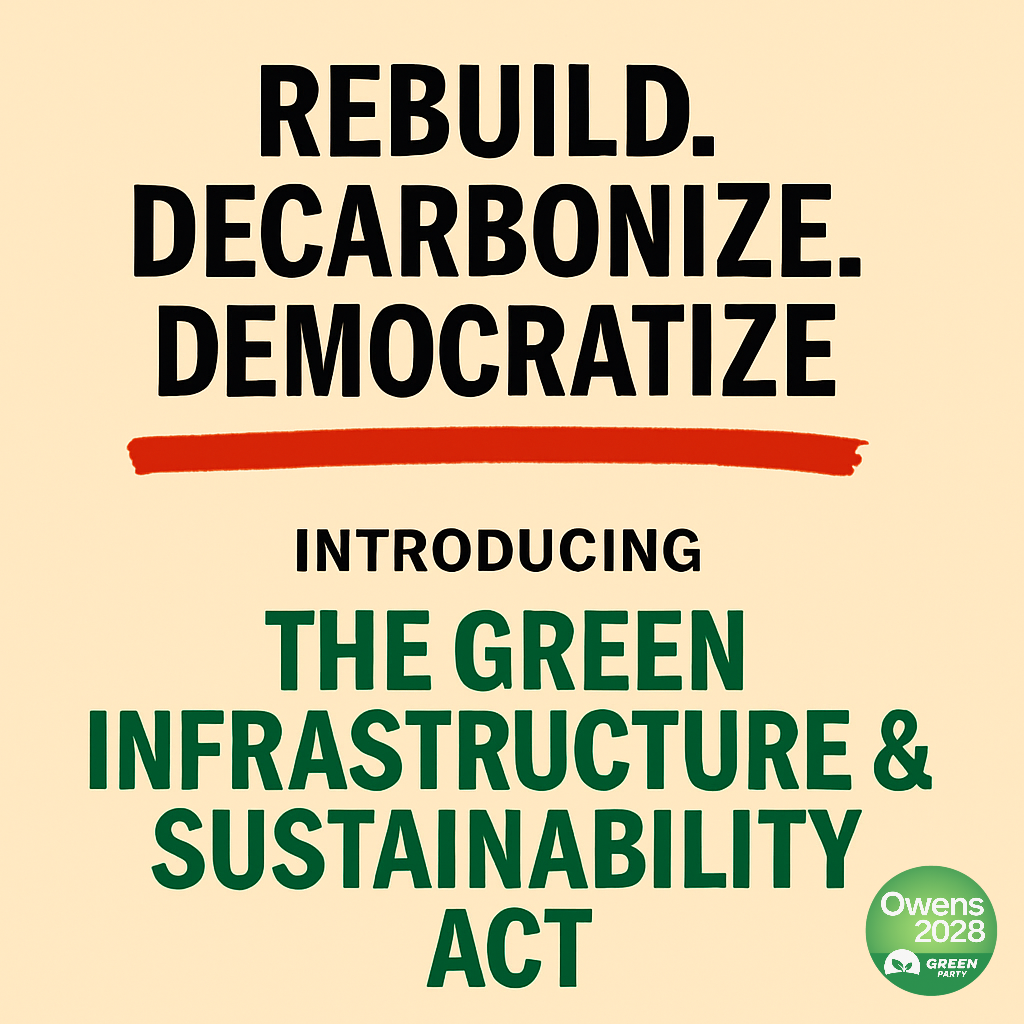
Green Infrastructure & Sustainability – Building the Future We Deserve
For decades, America’s infrastructure has crumbled beneath our feet. Our roads crack, our bridges age into obsolescence, and our power grids—meant for a bygone era—strain under modern demand. From outdated water systems in Flint to failed grids in Texas, the signs of a system stretched to its limits are everywhere.
But what if we didn’t just fix it? What if we rebuilt it—smarter, greener, and stronger than ever before?
The Green Infrastructure & Sustainability Act, part of the Green Budget Framework, proposes exactly that. Not just band-aids, not half-measures, but a national transformation: a bold reinvestment into public works, clean energy, and sustainable systems that serve people, not profit.
The Populist Problem: A Nation Built for Yesterday
Populism starts with naming the truth: Our infrastructure was built for a world that no longer exists.
- It was built when cars were king and public transit was an afterthought.
- It was built when fossil fuels were limitless and pollution was someone else’s problem.
- It was built without the voices of frontline communities, Indigenous peoples, or working families.
Today, the wealthiest corporations exploit this decay:
- Private water companies swoop in after public systems fail.
- Big energy conglomerates block the transition to renewables.
- Wall Street-backed developers gentrify instead of rebuild.
This is what happens when you treat infrastructure like a commodity, not a public good.
The Green Budget Solution: Rebuilding for People and Planet
The Green Infrastructure & Sustainability Act flips the equation. It proposes a 10-year, federally funded investment that will:
- Modernize public infrastructure for climate resilience and economic justice.
- Create millions of good-paying jobs through union-backed green construction.
- End corporate capture of critical public resources.
Let’s break it down:
1. A National Rebuild for the 21st Century
- Roads, bridges, tunnels, and public transit will be rebuilt with climate-safe materials and zero-emission designs.
- Lead pipes and toxic water infrastructure will be replaced across the country, with priority for communities most harmed.
- Power grids will be updated for solar, wind, geothermal, and battery storage to create regional resilience.
This isn’t just repair. It’s rebirth.
2. A New Jobs Boom: The Green Workforce
- Federally backed projects will require union labor, fair wages, and community hiring mandates.
- A Green Worker Transition Fund will help retrain fossil fuel workers into high-growth green industries.
- Local governments and Tribes will receive direct funding for shovel-ready projects.
Jobs are the heartbeat of infrastructure. This Act ensures they stay in local hands, not outsourced.
3. Sustainable Systems for Future Generations
- Zero-emission school buildings, retrofitted housing, and mass transit solutions will cut our national carbon output.
- National clean energy grid development will make our power systems more efficient and independent.
- Regenerative agriculture and sustainable land use will be funded alongside hard infrastructure.
This is how we make infrastructure part of the climate solution, not the problem.
Cross-Party Comparison: Who’s Really Rebuilding America?
- Democrats passed the Bipartisan Infrastructure Law, but allowed for major private sector involvement and fossil fuel loopholes.
- Republicans often push for infrastructure “modernization,” but rarely prioritize clean energy, worker protections, or environmental equity.
- Independents and populist-minded voters often demand decentralization and efficiency—but lack a unified plan to scale it nationally without relying on profit-first contractors.
The Green Budget approach doesn’t tinker around the edges. It goes big, unapologetically:
Rebuild for the people. Decarbonize. Democratize. Deliver.
Why Populists Should Care
This is about control. Right now:
- Big oil controls your utility bill.
- Private rail monopolies control your shipping and supply chains.
- Wall Street firms buy up water rights, rural housing, and farmland.
The Green Infrastructure & Sustainability Act puts those systems back under democratic, community-rooted control. It doesn’t just build better. It builds power where it belongs: in the hands of the people.
Funding the Future: Where the Money Comes From
This plan doesn’t rely on fantasy math or trickle-down assumptions. Here’s how it’s funded:
- Wall Street Tax (Main Street Reinvestment Act) – A micro-tax on high-frequency trades and speculative transactions that generates hundreds of billions.
- Defense Realignment Savings – Redirecting funds from unnecessary overseas bases and outdated weapons programs.
- Public Asset Reclamation – Ending private monopolies on public goods (water, energy, rail) and converting them into community-driven utilities.
- Cannabis Public Revenue (preview of Episode 8) – A federally taxed legal cannabis market that funds local reinvestment.
- Climate Bond Program – Low-interest, long-term green bonds targeted to citizens and municipalities, not megabanks.
In other words: tax the excess, repurpose the waste, and reinvest where it counts.
Ripple Effects: What Happens When We Build Smart
- Cleaner air and water mean healthier communities and lower healthcare costs.
- Better transit means more freedom, lower emissions, and stronger local economies.
- Job access in green industries reduces poverty and boosts upward mobility.
- Climate-resilient systems protect the vulnerable and reduce disaster costs.
This is what populist sustainability looks like. Not some elite technocratic dream. Real work. Real pay. Real change.
The Road Ahead: Laying the Groundwork for Cannabis Justice
With our economic core restructured, it’s time to talk about how we fund the future while healing the past. That means looking at:
- Legalization done right
- Reparative justice for victims of the War on Drugs
- Smart public revenue models from cannabis and other plant medicines
I’m traveling coast to coast, meeting Greens, supporting down-ballot candidates, and connecting with you directly where you are. Unlike career politicians, I fund my journey by working gigs like DoorDash and Instacart—time that could be spent building real change.
If you believe in this movement and want to help me dedicate more of my time to meeting voters and supporting our shared mission, click the image below to show your support. Together, we can build something lasting for 2026, 2028, and beyond.

Episode 8: High Time for Justice – Legalization, Equity & Real Public Revenue Because building a just future means righting historic wrongs.