
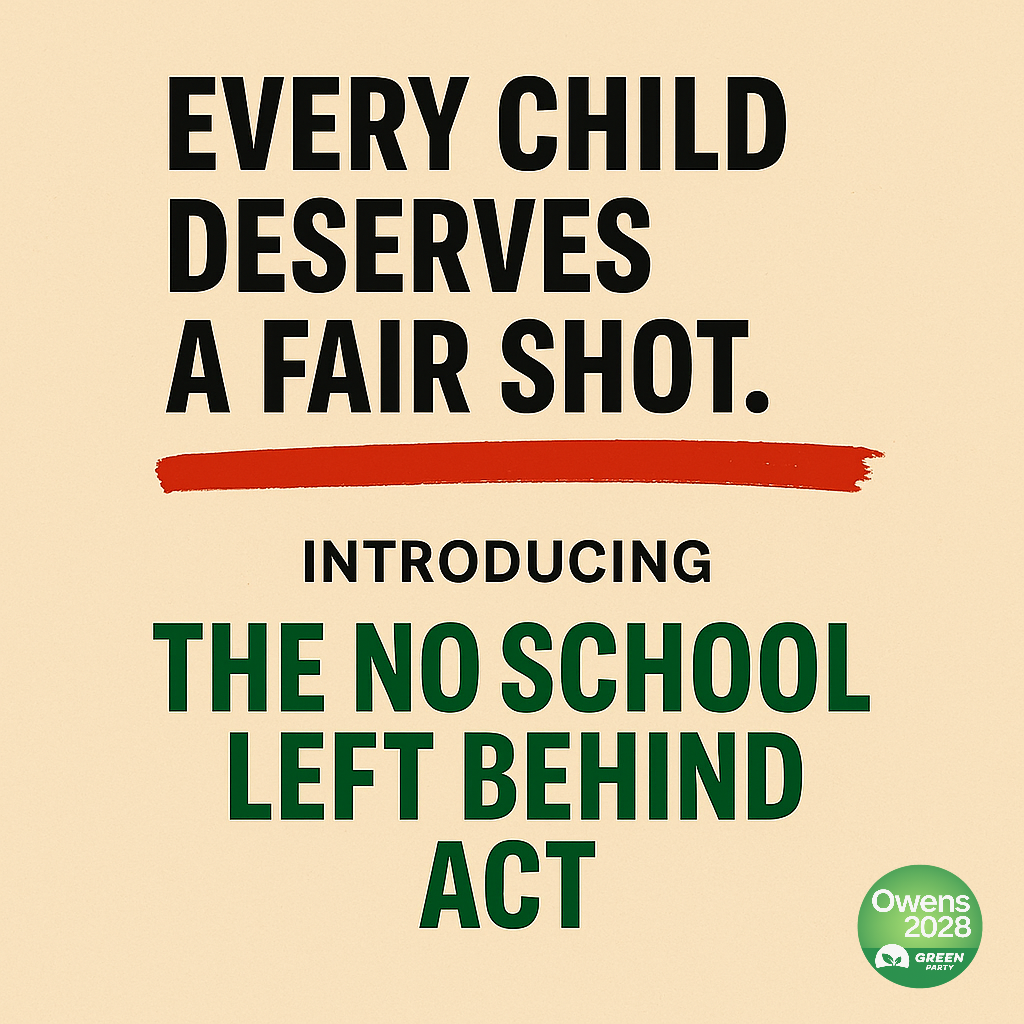
Fixing Our Broken Schools
If you want to see exactly where America’s priorities are, walk into a public school.
In too many communities, the story is the same:
- Ceiling tiles sag and leak when it rains, with buckets on the floor catching the drips.
- Textbooks are outdated and falling apart, some older than the kids using them.
- Teachers pay for basic supplies out of their own pockets because the budget ran dry in October.
- Classrooms are overcrowded, with one teacher juggling 30 or more students at once.
And then drive a few miles into a wealthier neighborhood.
The contrast is hard to ignore:
- Brand-new facilities with science labs, computer rooms, and art studios.
- Libraries and gyms fully stocked and gleaming, like small college campuses.
- Students with access to everything they need to thrive—AP classes, robotics programs, even esports teams.
This is the reality of American education in 2025:
Your child’s future depends more on their zip code than their talent, effort, or dreams.
And for all the speeches politicians give about “opportunity,” this is what kids actually get: a system built to lift up the wealthy and leave everyone else behind.
The Populist Problem: A Rigged Education System
Every election cycle, politicians—Democrats and Republicans alike—line up to declare: “Children are our future!”
But watch what they do, not what they say.
- They cut school budgets while handing tax breaks to billionaires.
- They approve bloated military budgets while teachers in rural districts are holding bake sales to buy supplies.
- They let wealthy districts hoard resources, while poor and rural schools are told to “do more with less.”
Who Wins and Who Loses
- Winners:
- Wealthy families who already had every advantage.
- Corporate testing and textbook companies profiting off broken systems.
- Politicians and donors who keep the cycle going.
- Losers:
- Kids born in the “wrong” zip code.
- Teachers working two jobs just to keep classrooms functioning.
- Communities watching opportunity vanish for the next generation.
This is a classic case of people vs. elites.
While working families sacrifice and teachers stretch themselves thin, corporations and political insiders thrive off a system they rigged.
Populism means calling this out and demanding that the people—our kids, our families—come first.
The Green Budget Solution: No School Left Behind Act
The Green Budget Framework starts with kids because strong schools create strong communities.
The No School Left Behind Act is the first strike against a system that rewards the wealthy while neglecting everyone else.
It’s not a band-aid—it’s a complete realignment of priorities.
Here’s how it works:
1. A National Education Lottery & Trust
We fund our schools outside the reach of corrupt politics.
- A new national lottery is created where all proceeds go to a permanent education trust.
- That trust guarantees baseline funding for every public school in the country.
- This ends the zip-code lottery—your kid’s opportunity won’t depend on your property taxes anymore.
Impact:
- Rural, tribal, and inner-city schools will finally have stable, guaranteed funding.
- Wealthy districts keep their local advantages, but no child in America is left behind again.
2. Closing the Resource Gap
Once baseline funding is secured, resources are allocated by need:
- High-need schools get priority investment for facilities, teachers, and technology.
- Equity replaces favoritism—political clout can’t decide which kids get a future.
3. Investing in Teachers and Students
Teachers are the backbone of education, and for too long, they’ve been treated as disposable.
The No School Left Behind Act ensures:
- Teachers stop paying for supplies out-of-pocket.
- Classrooms are modernized with labs, tech, and safe learning environments.
- Special education and enrichment programs get proper funding so every student can thrive.
When teachers thrive, students thrive.
When students thrive, communities thrive.
4. Local Control with National Support
Communities know their kids better than distant bureaucrats or testing companies.
- Funding comes from the top, but decisions stay local.
- Parents, teachers, and school boards decide how resources are used.
- No more endless testing mandates or corporate-driven policies.
This means the people closest to the classroom make the calls, while the federal government ensures fairness and stability.
What Real Change Looks Like
Here’s the difference the No School Left Behind Act makes:
- A rural district in Appalachia finally has working internet, modern classrooms, and enough teachers to reduce class sizes.
- An urban school in Chicago or Detroit no longer has to choose between repairing the roof or buying textbooks.
- Special-needs programs and arts classes aren’t treated like luxuries—they’re fully funded.
- Teachers focus on teaching, not side hustles or constant supply drives.
And most importantly:
Every child in America grows up knowing their country believes in their future.
Cross-Party Appeal: Why This Plan Unites America
This is not a left vs. right fight. It’s people vs. elites—and every party’s base gets something they care about.
- Republicans:
- Local control is protected—funding, not federal micromanagement, drives improvement.
- Strong schools strengthen families and reduce dependency on federal social programs.
- Democrats:
- Educational equity becomes real.
- Teachers and public schools are properly supported, fulfilling a core progressive goal.
- Independents & Non-Voters:
- The American promise—work hard and you can get ahead—finally becomes real for every zip code, not just wealthy ones.
- A solution that bypasses partisan gridlock appeals to those fed up with politics-as-usual.
This is a unifying populist solution.
When kids win, communities win. When communities win, the whole nation rises.
The Ripple Effect: Strong Schools, Strong America
Fixing schools isn’t just about grades and test scores—it transforms entire communities.
- Local economies improve because better schools attract families and investment.
- Crime rates drop as opportunity rises and kids have real paths to success.
- Generational cycles of poverty break when education is no longer a privilege of the wealthy.
This is how populism turns into progress:
We take money that’s been wasted on war, corporate bailouts, and elite indulgence, and put it where it changes lives for decades.
The Next Battle: Wall Street vs. Main Street
Fixing schools is the first fight in taking America back.
Because while our kids were learning in underfunded classrooms, Wall Street and corporate elites were draining our towns dry.
That’s our next mission.
I’m traveling coast to coast, meeting Greens, supporting down-ballot candidates, and connecting with you directly where you are. Unlike career politicians, I fund my journey by working gigs like DoorDash and Instacart—time that could be spent building real change.
If you believe in this movement and want to help me dedicate more of my time to meeting voters and supporting our shared mission, click the image below to show your support. Together, we can build something lasting for 2026, 2028, and beyond.

Episode 3: “Wall Street vs. Main Street – How We Rebuild Local Economies”
Because the people who built this country should never be crushed by the people who bought it.